
QUESTIONING?

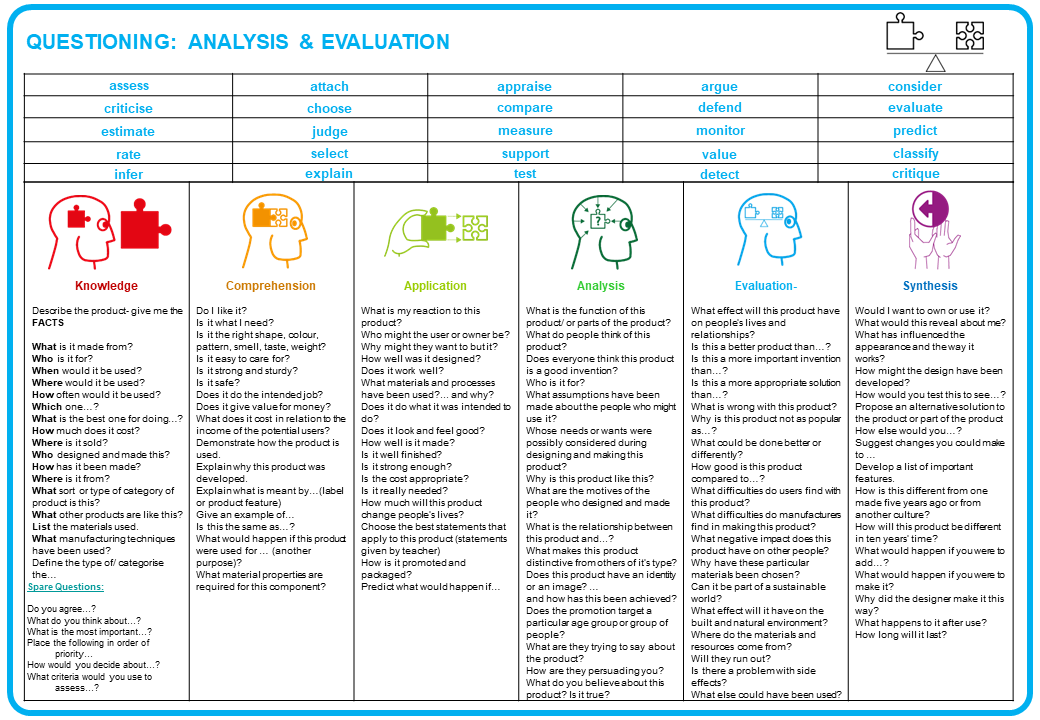

STEMS

KNOW
Can you list three ...?
Can you recall ...?
Can you select ...?
How did ______ happen?
How is ...?
How would you describe ...?
How would you explain ...?
How would you show ...?
What is ...?
When did ...?
When did _______ happen?
Where is . . . ?
Which one ...?
Who was ...?
Who were the main . . . ?
Why did ...?
How are ________and _____alike?
What is the main idea of _____?
What are the strengths and weaknesses of _________?
In what way is ________ related to _______?
Compare __ and ____ with regard to ___.
What do you think causes ____
How does ____ tie in with what we have learned before?
Which one is the best ____ and why?
What are some of the possible solutions for the problem of ____ ?
Do you agree or disagree with this statement ____ ?
What do you still not understand about ____ ?

UNDERSTAND
Can you explain what is happening . . . what
is meant . . .?
How would you classify the type of ...?
How would you compare ...?contrast ...?
How would you rephrase the meaning ...?
How would you summarise ...?
What can you say about ...?
What facts or ideas show ...?
What is the main idea of ...?
Which is the best answer ...?
Which statements support ...?
Will you state or interpret in your own
words ...?

APPLY
How would you use...?
What examples can you find to ...?
How would you solve _______ using what
you have learned ...?
How would you organise _______ to
show ...?
How would you show your understanding
of ...?
What approach would you use to…?
How would you apply what you learned to
develop ...?
What other way would you plan to ...?
What would result if ...?
Can you make use of the facts to ...?
What elements would you choose to
change ...?
What facts would you select to show ...?
What questions would you ask in an interview
with ...?

ANALYSE
What are the parts or features of ...?
How is _______ related to ...?
Why do you think ...?
What is the theme ...?
What motive is there ...?
Can you list the parts ...?
What inference can you make ...?
What conclusions can you draw ...?
How would you classify ...?
How would you categorise ...?
Can you identify the difference parts ...?
What evidence can you find ...?
What is the relationship between ...?
Can you make a distinction between ...?
What is the function of ...?
What ideas justify ...?

EVALUATE
What changes would you make to solve…?
How would you improve ...?
What would happen if...?
Can you elaborate on the reason...?
Can you propose an alternative...?
Can you invent...?
How would you adapt ________ to create a
different...?
How could you change (modify) the plot
(plan)...?
What could be done to minimise
(maximise)...?
What way would you design...?
Suppose you could _______ what would
you do...?
How would you test...?
Can you formulate a theory for...?
Can you predict the outcome if...?
How would you estimate the results for...?
What facts can you compile...?
Can you construct a model that would
change...?
Can you think of an original way for the ...?

CREATE
Do you agree with the actions/outcomes...?
What is your opinion of...?
How would you prove/disprove...?
Can you assess the value/importance of...?
Would it be better if...?
Why did they (the character) choose...?
What would you recommend...?
How would you rate the...?
What would you cite to defend the actions...?
How would you evaluate ...?
How could you determine...?
What choice would you have made...?
What would you select...?
How would you prioritise...?
What judgement would you make about...?
Based on what you know, how would you
explain...?
What information would you use to support
the view...?
How would you justify...?
What data was used to make the conclusion...?
COLD CALLING
- Ask class the questions
- Give Thinking Time
- Select someone to respond
- Respond to answer
- Select another student to respond
THINK, PAIR, SHARE
- Establish partners
- Set question with time frame
- Build in Thinking time
- Circulate to listen to pairs talking
- Use cold call to sample responses
SHOW ME THE BOARDS
- Ensure each student has a board and pen/eraser
- Set question with time frame
- Build in thinking time
- Signal: 3-2-1 and show me
- Sample student responses and follow up
CHECK FOR UNDERSTANDING
- Cold call asking WHAT not if
- Probe with short dialogue
- Follow-up with more checking dialogues
- Explore differences and details
- Re-teach, defer or move on
SAY IT AGAIN BETTER
- Ask a student a question
- Acknowledge the first response
- Give supportive and formative feedback
- Invite student to ‘say it again better.’
- Respond to the improved response
PROBING QUESTIONS
- Ask a student a question
- Follow up with a probing question
- Listen and probe further
- Ask another student to continue
- Check for understanding from others
PROCESS QUESTIONS
- Model your thinking
- Emphasise HOW and WHY
- Ask students to explain their ideas and choices
- Ask how similar alternative questions or problems might be approached
REDRAFTING
- Establish the standards with exemplars
- Set the task, with success criteria
- Provide or generate feedback
- Give time to repeat the task
- Repeat multiple feedback and improvement cycles
SELECTIVE MARKING
- Set an extended task and collect the work
- Select a specific section to focus on
- Provide actionable feedback
- Initiate redrafting of selected section
- Translate ideas to remainder of the task
NO OPT OUT
- Ask a question or cold call
- Explore ‘Don’t Know’ responses
- Provide correct answer
- Go back and check for understanding
- Break the ‘Don’t Know’ defensive habit
HANDS UP FOR ASKING OR IDEAS
- Establish the expectations
- Welcome the input and reinforce the expectation
- Answer the question
- Engage with ideas
- Engage others and check for understanding
NORMALISE ERROR OR UNCERTAINTY
- Assume and embrace uncertainty
- Explore misconceptions and errors while explaining
- Embrace error during questioning
- Emphasise uncertainty with metacognitive talk
- Explore errors in questioning
FEEDBACK THAT MOVES FORWARD
- Focus forwards
- Keep it positive and specific
- Match the message to the student
- Avoid satnav syndrome
- Reduce feedback over time
FEEDBACK AS ACTIONS
- Redraft or redo
- Rehearse or repeat
- Revisit respond to more questions
- Relearn material and retest
- Research and record
WHOLE CLASS FEEDBACK
- Read through student’s work
- Note the strengths
- Note the areas for improvement
- Give the feedback
- Give improvement time
SPOT YOUR MISTAKES
- Evaluate student’s work
- Guide the process
- Invite the students to find the mistakes
- Provide scaffold support
- Give time for corrections and re-evaluate
QUESTIONING AND FEEDBACK SUCCESS CRITERIA
- Examine exemplars at different standards
- Establish the success criteria for a task
- Check for understanding
- Assess work against the criteria
- Initiate an improve cycle
RANDOMISED QUESTIONING
- Set up a randomising system; establish the routine
- Ask the class the question and give thinking time
- Initiate the random selection
- Ask the selected student and probe
- Repeat the process